

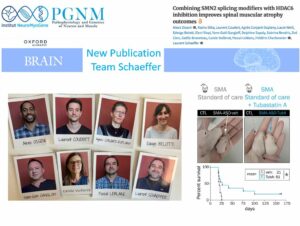
🚨 New paper just out in Brain journal : We show that HDAC6 inhibition could represent a valuable additional SMN-independent therapy to restore muscle function in SMA.
Spinal muscular atrophy (SMA) is a severe neuromuscular disorder caused by SMN gene defects. It leads to motor neuron death and muscle weakness. Without treatment, most affected children don’t survive past age two. Recently, new gene therapies help SMA children survive, but treated patients now face ongoing muscle atrophy and functional deficits, creating a novel clinical presentation. Over the last years, treatments of various animal models of neuromuscular disorders have shown the ability of inhibitors of the non-conventional histone deacetylase 6 (HDAC6) to reduce muscle atrophy.
This study examines HDAC6 inhibition’s impact on muscle cell differentiation and tests in vivo if combining it with new standard SMA treatments improves muscle and overall condition in SMA mice. Here, we report that HDAC6 controls myotube formation and maturation in vitro. In particular, HDAC6 inhibition increases the size of SMA patients-derived muscle primary myotubes. In vivo, when combined with ASOs inducing exon-7 inclusion in SMN2 RNA, HDAC6 systemic inhibition strongly improved muscle strength, mass, function, and longevity of SMA-like mice model.
These findings provide evidence that selective inhibition of HDAC6 improves myogenic progression. Hence, HDAC6 inhibitors are good candidates to ameliorate persisting symptoms of SMA patients treated with the new standard of care.
Alexis OSSENI, Frédéric Charbonnier and Laurent Schaeffer
Thanks to first author Rasha Slika !!!
and our collaborators, Laurent Coudert , Agnes Duplany , Laure Weill , Edwige Belotti , Eleni Siopi , Yann-Gaël Gangloff , Delphine Sapaly , Sabrina Bendris , Zoé Clerc , Gaëlle Bruneteau , Carole Vuillerot and Pascal Leblanc.
Thanks to the Institut NeuroMyogène Université Claude Bernard Lyon 1, the University Paris Cité, the AP-HP, Assistance Publique – Hôpitaux de Paris and the Hospices Civils de Lyon – HCL .
We also thank the support of the Inserm, ANR (Agence nationale de la recherche) via the RHU SMART (SMA Muscle Atrophy Remediative Therapy) (ANR-21-RHUS-0007) a FRANCE 2030 project, Pôle stratégique MyoNeurALP an AFM-Téléthon strategic plan, the Fondation pour la Recherche Médicale and the Fondation Maladies Rares.